Translated using Google Translate – http://www.nyteknik.se/nyheter/energi_miljo/vindkraft/article3877156.ece
Author: Charlotta von Schultz
Published January 21,
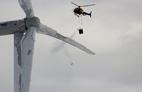
A hot water quickly melts away ice from the blades. The new method is one of several innovations that will secure electricity in the wintry wind farms.
Glaciated rotor blades are the scourge of wind turbine owners in cold climates. Alpine Helicopter in Constance has developed a new way to kick-start production when the ice forces the turbines stop: a helicopter that sprays hot water.
– It takes us about 1.5 hours to process a sharp occurrence of icing wind turbines, says CEO Mats Widgren.
Last winter, the method was tested with good results in Skellefteå Kraft’s wind farm in the low mountain Uljabuouda in Arjeplog. During the year, the technology has been refined, and now it is ready for use.
The water is heated over night using a truck equipped with a 260 kW oil burner. When morning dawns are 44 cubic meters of the 60-degree water in the tanks, and the helicopter can start running in the shuttle to the icy wind turbine.
Each turn takes it with him 850 gallons of water in a tank with a power sprayer. To succeed with icing flow must be high, and no more, the whole idea is sprayed out in two minutes. The method has been tested in temperatures down to minus 20 degrees without problems, according to Mats Widgren.
To carry out the operation required three people. A helicopter pilot, an operator controls the syringe by means of a joystick and a person at the truck, which ensures that the helicopter can rapidly replace the empty tank by a full.
Alpine Helicopter addressed both to wind turbines that have no system for deicing and turbines that have systems that do not fully work.
– The cost to deice a turbine is equivalent to two days of electricity. The decision is easy if you have an occurrence of icing wind turbines and the weather service promises continued cold, says Mats Widgren.
The question of ice on wind turbine is sensitive, and there are no official figures on the amount of electricity that is lost each winter in the Swedish wind farms.
– Anyone who builds wind energy in cold climates to contend with ice problems, and my assessment is that the loss of production of about ten percent of the turbines has been de-icing system, said Mikael Lindmark, CEO of Blaiken Wind.
The wind farm, located in the Large Blaiken between Storuman and Sorsele, built by Skellefteå Kraft and Fortum. When the park is fully developed with 90 turbines will be the one of the largest wind farms with a total power of 225 MW.
So far, 60 turbines from the German supplier Nordex operational. They have an electric heating foil on the rotor blades to prevent ice growth.
Mikael Lindmark says that the technique worked well but that does form ice which lowers production. Therefore, the 30 new turbines to be installed in the park in April received dual anti-icing system – both a laminated electrically heated foil on the rotor blades and the hot air circulating inside the leaves.
Both methods already in use in many turbines, but Mikael Lindmark is not aware that the combined commercial operation earlier.
The turbines produced by the Chinese Dongfang Electric Corporation and will be operational in the fall.
Production Losses: A heavy icing can force the turbine to stop completely. Less ice coatings can reduce electricity when the blade aerodynamics deteriorate.
Wear: If ice forms on the blades may cause imbalance and vibration that can damage the plant. Bearings and gearbox, for example, take a beating.
Ice throw: ice pieces can come loose and ejected with great force. In the worst cases, they can damage the rotating blades, or people or property in the vicinity.
Noise: Noise levels may increase when the rotor blade surface becomes uneven.


1 Comment